Recently, Prof. Wei Lan’s team at the School of Computer, Electronics and Information in Guangxi University (GXU) has made new progress in multi-view clustering. The related research paper is titled “CAFE: Cross-View Adaptive Fusion and Cluster Center Enhancement for Robust Multi-View Clustering,” published in the IEEE Transactions on Pattern Analysis and Machine Intelligence, an international journal in the field of artificial intelligence. GXU is the first affiliation, with Wei Lan as the first author. The paper is co-authored with Harbin Institute of Technology (Shenzhen), Guangxi Normal University, Griffith University (Australia), the University of Leicester (UK), and Shenzhen University of Advanced Technology.
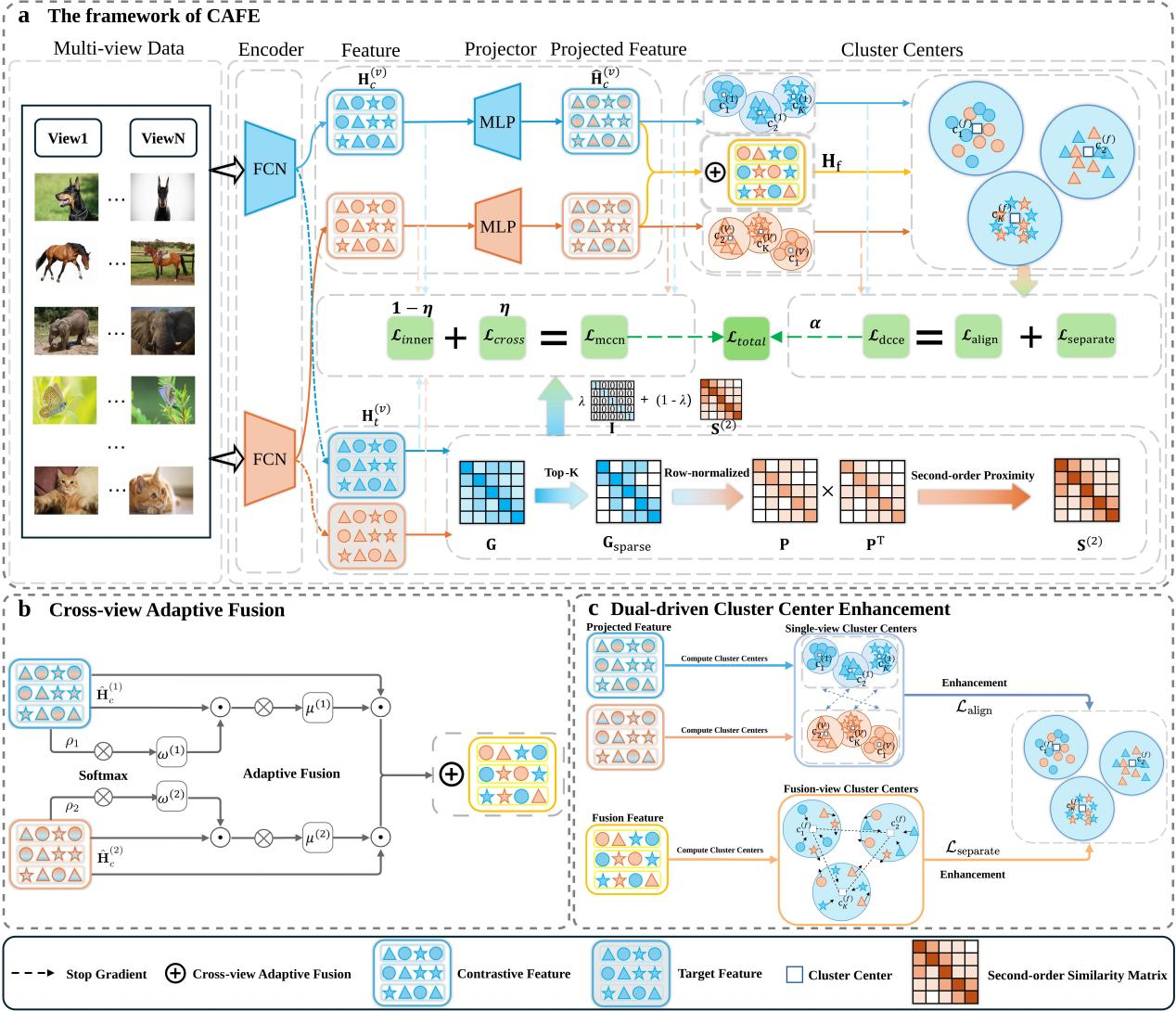
A single object can often be described from multiple perspectives. Multi-view clustering aims to integrate information from these perspectives to automatically discover latent categories in data. However, simply concatenating or averaging information across views can obscure view-specific cues, and the cluster centers derived from different views may not align, even causing genuinely similar samples to be misclassified as distant. How to effectively fuse multi-view information to achieve precise clustering is a key research problem in multi-view clustering.
Addressing this issue, the team proposes a new multi-view clustering method, CAFE, achieving three main advances. They find that CAFE can dynamically adjust the information fusion strategy according to view and sample characteristics, ensuring that all cues are used appropriately and avoiding information masking caused by mere concatenation or averaging. The study further coordinates the clustering centers between individual views and the fusion result, aligning the cluster structures across views to yield clearer clustering outcomes. By leveraging shared neighbor relationships among samples, the method also reduces instances where similar samples are incorrectly distinguished.
Experiments on public datasets show that the method achieves robust clustering performance under both complete and partially missing multi-view information. This work constructs a comprehensive framework for dynamic fusion, center coordination, and shared neighbor constraints, offering a new approach for fusing and analyzing complex multi-source data.

 Address: No.100,East Daxue Road,Xixiangtang District,Nanning, Guangxi,China
 Postal Code: 530004
 Tel: 86-771-3238863
 Email: gjc@gxu.edu.cn