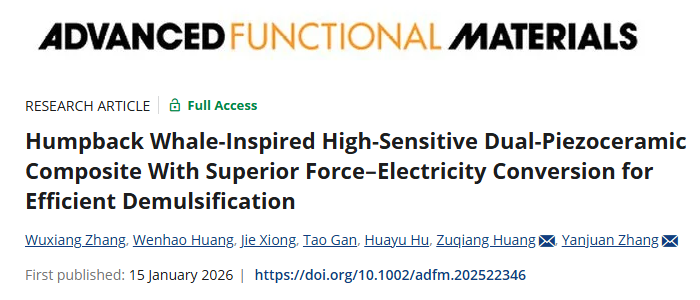
Recently, the research team focusing on Natural Polymer Modification and Eco-Functional Materials at GXU's School of Chemistry and Chemical Engineering has made new progress in the application research of eco-functional Nixing Pottery. The research findings have been published in the international academic journal Advanced Functional Materials under the title "Humpback Whale-Inspired High-Sensitive Dual-Piezoceramic Composite With Superior Force-Electricity Conversion for Efficient Demulsification." The first author of the paper is Wuxiang Zhang, a doctoral student of the class of 2021 at the School of Chemistry and Chemical Engineering. The corresponding authors are Professor Zuqiang Huang and Associate Professor Yanjuan Zhang from the same school. Guangxi University is the sole institution responsible for this work.
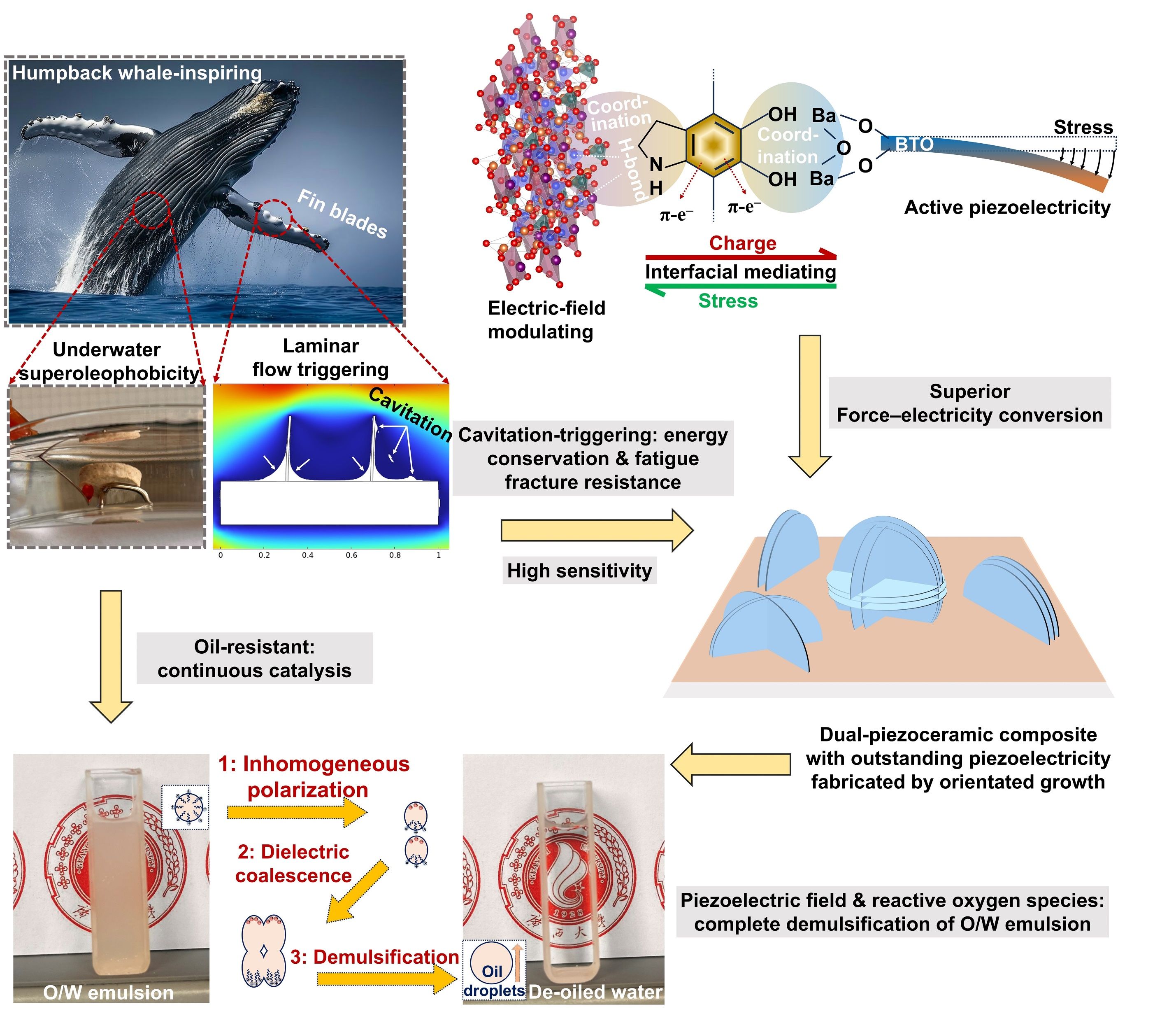
Safe and sustainable piezocatalytic technology holds broad application prospects in the field of water purification. However, the inherent rigidity of piezoceramics makes achieving excellent piezocatalytic efficiency quite challenging, as the process typically requires substantial energy consumption and presents a risk of fatigue fracture in the piezoceramics. To address this, the team drew inspiration from the irregular nodules on the leading edge of a humpback whale's pectoral flippers, which create cavitation effects and flow vortices in turbulent water. Using eco-functional Nixing Pottery, which possesses spontaneous polarization properties, as the base material, they synthesized a super-wetting dual-piezoelectric composite material with high force-electric sensitivity. This was achieved by directionally growing barium titanate after biomimetic modification with polydopamine. Under gentle mechanical force triggering, this biomimetic composite material generated a key cavitation effect. The coordination action of polydopamine enabled efficient stress and charge transfer between the eco-functional Nixing Pottery and barium titanate. Consequently, the composite material exhibited an excellent piezoelectric response, generating a localized piezoelectric field of 1.46×10⁹ V/m and reactive oxygen species, thereby avoiding fatigue fracture and high energy consumption. Using ordinary stirring as the mechanical force, the material achieved complete demulsification of an oil-in-water emulsion within 15 minutes through electric field polarization of oil droplets and degradation of the emulsifier by reactive oxygen species, demonstrating a performance 3.3 to 4.0 times superior to comparative catalysts. This strategy enables sustainable and efficient demulsification, showing significant application potential for the large-scale purification treatment of oily wastewater.
It is reported that the team's developed technology for preparing eco-functional Nixing Pottery through mechanical activation coupled with biomineralization has been transferred to an enterprise for achievement transformation and industrialization, injecting new vitality into Qinzhou Nixing Pottery, a national-level intangible cultural heritage. The External Communication Center of Guangxi Radio and Television has produced a special feature on the scientific research and industrial application of this technology, titled "University-Enterprise Joint Innovation: Technology Empowers the Upgrading of the Nixing Pottery Industry." The research team is systematically investigating its applications in fields such as food processing, fruit preservation, water treatment, and industrial catalysis, and has published multiple academic papers in international journals including Advanced Functional Materials, Journal of Materials Science & Technology, Chemical Engineering Journal, Food Chemistry, and Journal of Hazardous Materials.

 Address: No.100,East Daxue Road,Xixiangtang District,Nanning, Guangxi,China
 Postal Code: 530004
 Tel: 86-771-3238863
 Email: gjc@gxu.edu.cn