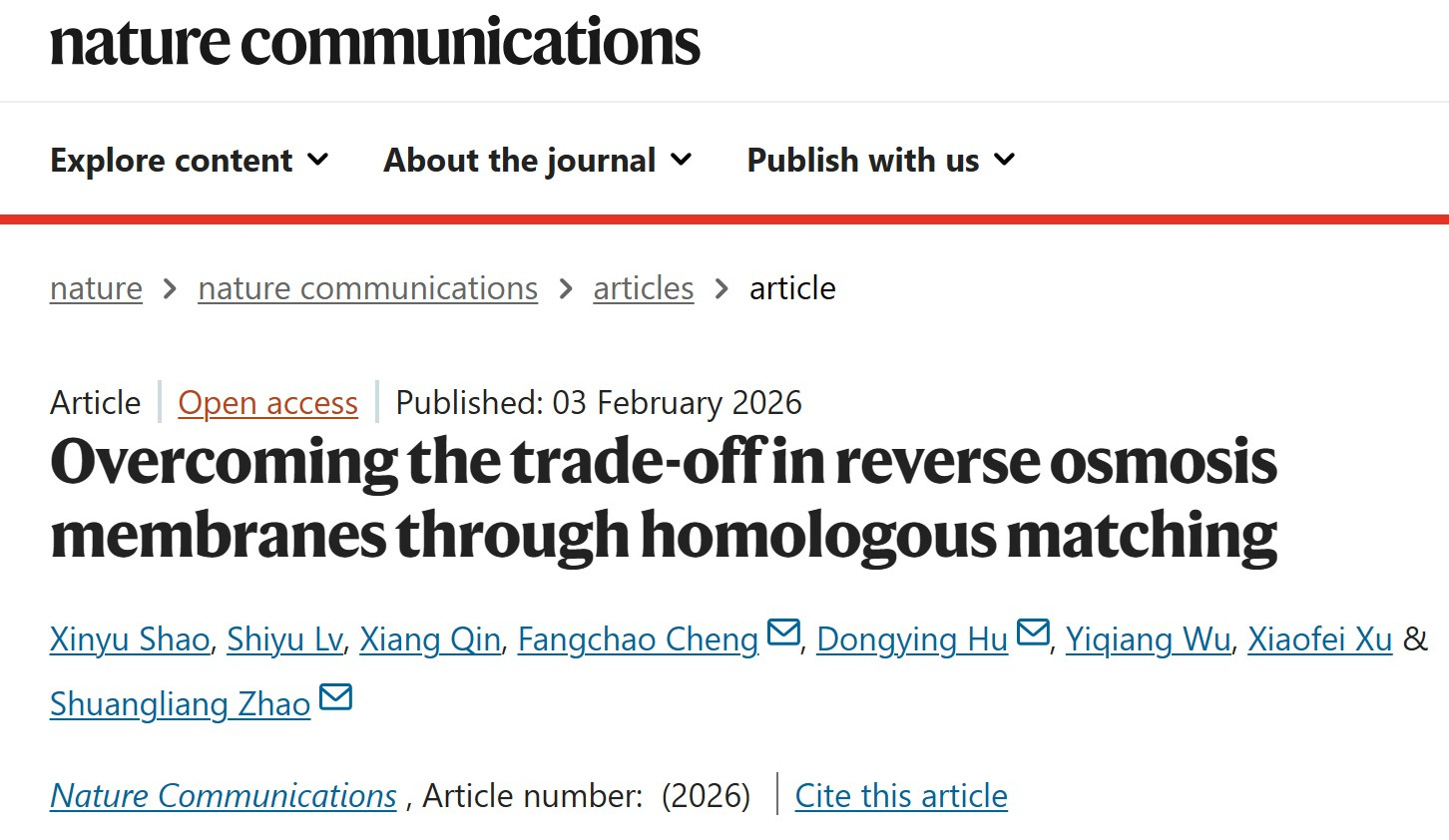
Recently, the Structural Thermodynamics and Micro/Nano Chemical Engineering Team at Guangxi University reported new advances in biomass-based separation membrane materials. The research, entitled “Overcoming the trade-off in reverse osmosis membranes through homologous matching,” was published in the internationally renowned journal Nature Communications.
The co-first authors are Shao Xinyu, a 2022 master’s student from the School of Resources, Environment and Materials, and Lü Shiyu, a 2022 doctoral student from the School of Chemistry and Chemical Engineering. The corresponding authors are Professor Zhao Shuangliang (School of Chemistry and Chemical Engineering), and Associate Professors Cheng Fangchao and Hu Dongying (School of Resources, Environment and Materials). Guangxi University is the first and sole corresponding institution of the paper.
Amid the global freshwater crisis, developing high-performance separation membranes from biomass resources represents a key pathway toward both the high-value utilization of biomass and the sustainable advancement of membrane separation technologies. As an important biomass-derived material, cellulose triacetate has demonstrated significant potential in reverse osmosis desalination. However, like most membrane materials, it suffers from a fundamental scientific challenge: the intrinsic trade-off between permeability and selectivity. This “see-saw” relationship has long constrained the high-quality development and broader application of biomass-based membrane technologies.
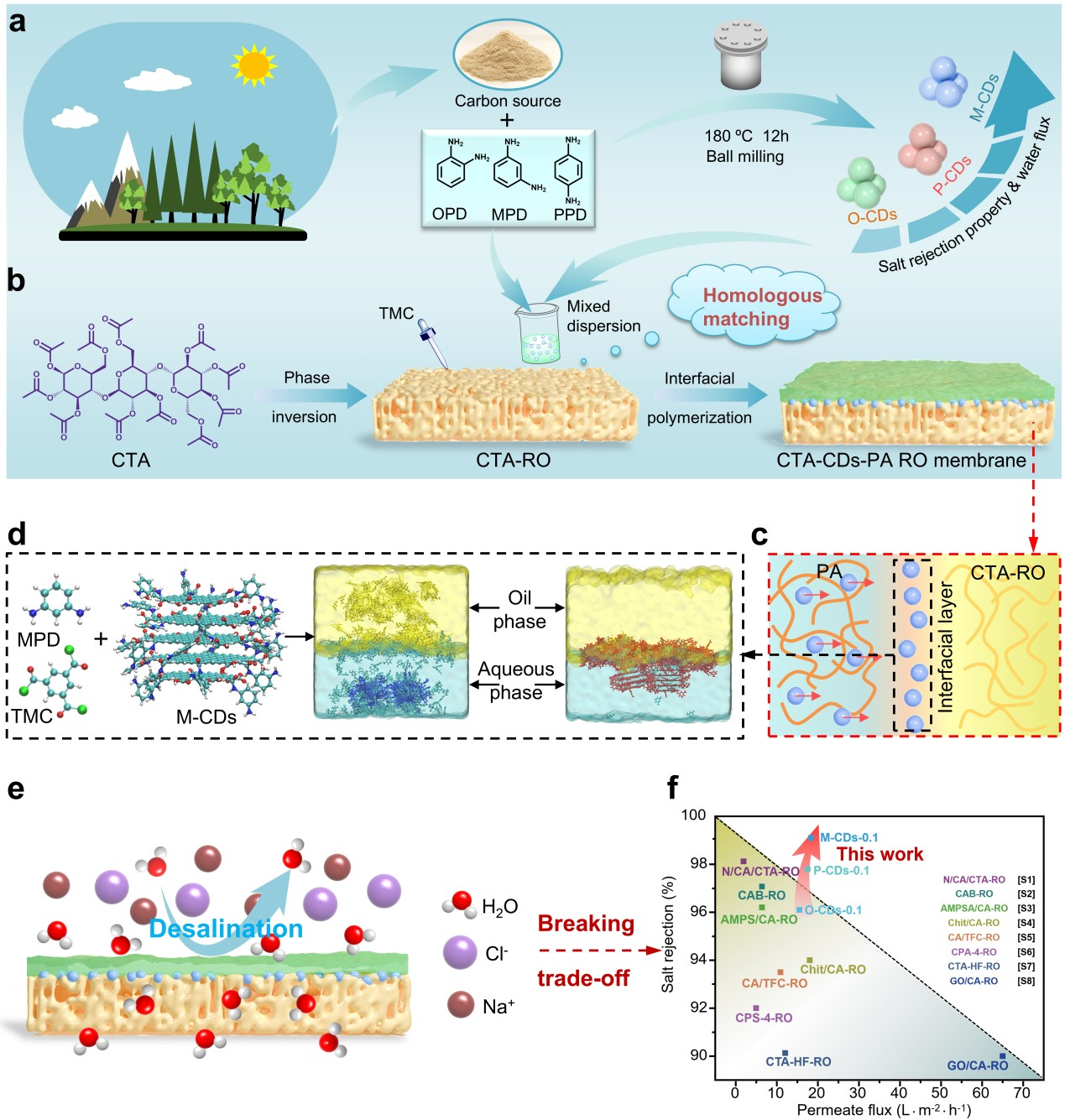
To overcome this bottleneck, the research team focused on cellulose triacetate membranes and introduced biomass-derived carbon nanomaterials as a key design element. They proposed an original interfacial polymerization regulation strategy termed “homologous matching.” The core innovation lies in synthesizing carbon quantum dots (CQDs) via a simple hydrothermal method, using precursors structurally homologous to m-phenylenediamine (MPD), and incorporating them into the interfacial polymerization process between cellulose triacetate and polyamide.
Leveraging the structural similarity and molecular interactions between the carbon quantum dots and MPD monomers, the team achieved precise guidance and optimization of the interfacial polymerization process. This enabled fine regulation of the crosslinking density and microstructure of the polyamide layer.
The study demonstrates that the homologous matching mechanism facilitates monomer diffusion and optimizes reaction kinetics, guiding the formation of a thinner, denser, and more hydrophilic selective layer. As a result, both water flux and salt rejection of the reverse osmosis membrane are simultaneously enhanced, effectively overcoming the long-standing trade-off between permeability and selectivity in conventional membrane materials.
In addition, the hydrogen-bonding network established between the carbon quantum dots and m-phenylenediamine significantly improves the membrane’s chlorine resistance, addressing the common drawback of reduced stability often associated with traditional modification strategies. Molecular simulations further reveal that the carbon quantum dots enable efficient separation by promoting water-cluster transport while simultaneously impeding ion permeation.
This work successfully breaks the trade-off bottleneck of cellulose-based reverse osmosis membranes and highlights the critical role of “homologous structural matching” in nano–polymer interfacial engineering. The findings establish a generalizable new principle for the structural design and performance enhancement of high-performance, green materials derived from biomass. The strategy is expected to promote the high-value utilization of biomass resources and accelerate the development of sustainable membrane technologies toward greater efficiency, stability, and environmental compatibility.
This research was supported by the Guangxi Science and Technology Innovation Platform Program, the Guangxi Major Science and Technology Special Program, the National Natural Science Foundation of China, and the Guangxi University Natural Science and Technology Innovation Development Doubling Plan.

 Address: No.100,East Daxue Road,Xixiangtang District,Nanning, Guangxi,China
 Postal Code: 530004
 Tel: 86-771-3238863
 Email: gjc@gxu.edu.cn