Recently, faculty members of the Astrophysics Research Team in the School of Physical Science and Engineering Technology at Guangxi University (GXU), in collaboration with researchers from Anhui University, the Purple Mountain Observatory of the Chinese Academy of Sciences, and other institutions, detected evidence of high-energy gamma-ray emission from a superluminous supernova using 15 years of observational data collected by the Fermi Large Area Telescope (Fermi-LAT).
The research findings, entitled “Evidence for GeV Emission from the Superluminous Supernova SN 2017egm,” were published in the international physics journal Physical Review Letters and were selected as an Editors’ Suggestion.
Shang Li, Associate Professor at Anhui University, and Yunfeng Liang, Associate Professor in the School of Physical Science and Engineering Technology at GXU, served as co-first authors of the paper. Yizhong Fan, Research Professor at the Purple Mountain Observatory of the Chinese Academy of Sciences, served as the corresponding author.
Superluminous supernovae (SLSNe) are among the most violent stellar explosions in the universe, with optical luminosities reaching 10 to 100 times greater than those of ordinary supernovae. However, the energy source powering these extreme events has long remained an unresolved question in astrophysics.
The research team focused on SN 2017egm, one of the nearest known superluminous supernovae to Earth, and conducted a systematic analysis of Fermi-LAT observations in its direction. The results revealed that approximately two months after the supernova explosion, a significant transient gamma-ray signal emerged near the location of SN 2017egm and remained active for several months.
Both the observed peak time and luminosity of the gamma-ray emission are in excellent agreement with the theoretical predictions of the magnetar central-engine model. This discovery provides crucial evidence supporting the existence of a magnetar-powered engine in superluminous supernovae and opens a new window for understanding the energy source and physical mechanisms underlying these extraordinary cosmic explosions.
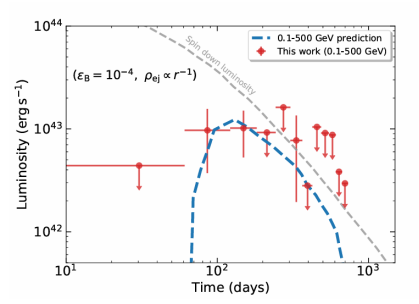
Figure: The GeV gamma-ray emission from the superluminous supernova detected by Fermi-LAT is consistent with the predictions of the magnetar model.
This research was supported by the National Natural Science Foundation of China (NSFC), the National Key Research and Development Program of China, and the Xplorer Prize funded by the New Cornerstone Science Foundation, among other funding programs.

 Address: No.100,East Daxue Road,Xixiangtang District,Nanning, Guangxi,China
 Postal Code: 530004
 Tel: 86-771-3238863
 Email: gjc@gxu.edu.cn