Recently, a research team led by Professor Zhang Lin and doctoral student Zhang Quanjun from the School of Economics at Guangxi University (GXU) published a research article entitled “Knowledge Stickiness and Technological Concentration in the AI Industry: An Empirical Study of Chinese Cities” in Scientific Reports, a renowned SCI-indexed international journal published under the Nature Portfolio. GXU is listed as the first-affiliated institution.
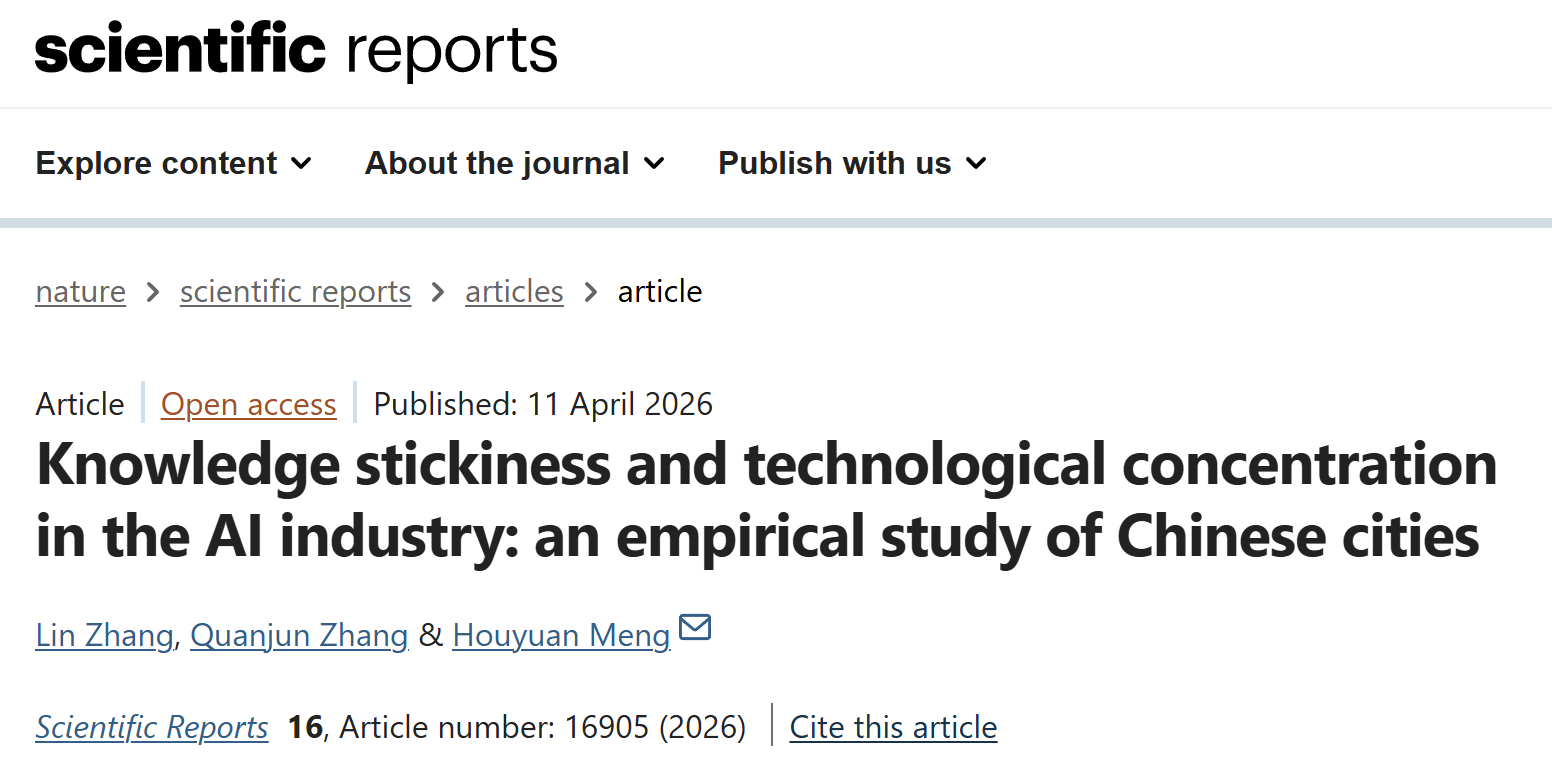
Against the backdrop of artificial intelligence emerging as a key general-purpose technology driving regional industrial upgrading and technological transformation, the study systematically investigates the evolutionary relationship between knowledge stickiness and urban technological agglomeration in the AI industry. Drawing on the dual dimensions of knowledge diffusion and path dependence, the research team developed an original city-level measurement framework for AI knowledge stickiness.
The study finds an inverted U-shaped relationship between knowledge stickiness and technological concentration. Moderate levels of knowledge stickiness facilitate technological accumulation, whereas excessive stickiness can lead to path dependence and inhibit innovation. The research further demonstrates that technological complexity significantly moderates both the strength and curvature of this nonlinear relationship. Heterogeneity analyses reveal that the inverted U-shaped effect is more pronounced in eastern Chinese cities and small- and medium-sized cities. In contrast, large cities exhibit greater resilience to high levels of knowledge stickiness due to their more diversified knowledge networks and broader external linkages.
Scientific Reports is a highly influential multidisciplinary academic journal within the Nature Portfolio, covering a broad range of disciplines, including engineering, mathematics, earth and environmental sciences, and life and health sciences. The journal is committed to advancing open science and interdisciplinary research and is recognized as one of the world's largest open-access journals, ranking in the JCR Q1 category.
This achievement reflects the School of Economics’ efforts to support Guangxi’s AI-oriented development strategy toward ASEAN and contribute to the development of the China–ASEAN Digital Silk Road. Looking ahead, the School will continue to pursue the development pathway of “R&D in Beijing, Shanghai, and Guangzhou; integration in Guangxi; and application in ASEAN.” It will focus on AI-enabled cross-border trade, industrial-chain collaboration, and digital governance, while strengthening joint research initiatives with ASEAN think tanks to help build a leading hub for China–ASEAN cooperation in artificial intelligence innovation.

 Address: No.100,East Daxue Road,Xixiangtang District,Nanning, Guangxi,China
 Postal Code: 530004
 Tel: 86-771-3238863
 Email: gjc@gxu.edu.cn