On January 4, a delegation led by Akmal Sabarudin, Director of the Global International Relations Center of the National University of Malaysia, visited GXU and held a discussion with representatives from university’s institution. The meeting was chaired by Yu Wenjin, Vice President of the university.
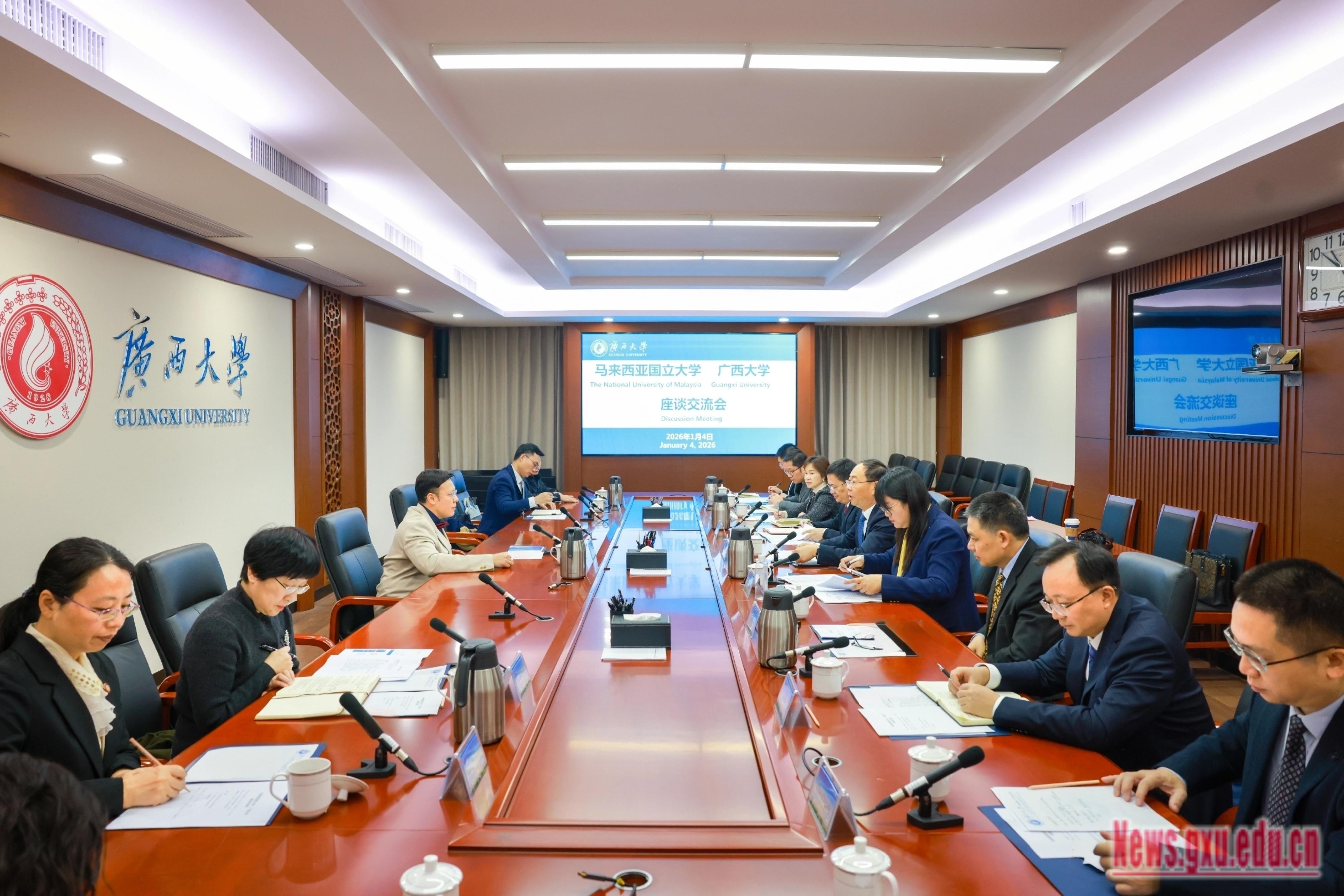
Yu Wenjin extended a warm welcome to the delegation. He noted that China and Malaysia share a profound friendship, and Guangxi, as a frontier window for China’s opening-up to ASEAN, has achieved fruitful results in industrial cooperation, education, culture, and tourism with Malaysia. Strengthening collaboration with the National University of Malaysia is not only an important measure to implement the China-ASEAN education cooperation strategy but also a necessary requirement to serve the nation’s broader opening-up and promote regional common development. As a "Double First-Class" university deeply rooted in Guangxi and focused on ASEAN, Guangxi University looks forward to further building consensus with the National University of Malaysia. Key areas of cooperation will include faculty and student exchanges, joint training programs, scientific research collaboration, and co-hosting international conferences. In particular, in such priority fields as artificial intelligence, semiconductors, green energy, and marine sciences, the two sides aim to establish interdisciplinary cooperation platforms, explore diversified models for Sino-foreign educational partnerships, and carry out various forms of exchange, including two-way student study tours, ensuring that the outcomes of collaboration benefit both faculties and students.
Akmal Sabarudin expressed gratitude for the thoughtful arrangements made by Guangxi University. He emphasized that the National University of Malaysia attaches great importance to cooperation with Chinese universities and was deeply impressed by Guangxi University’s solid academic foundation, distinct ASEAN-oriented characteristics, and strong research capabilities. He noted that this visit highlighted the high degree of alignment between the two universities in disciplinary development and talent cultivation, with particularly significant potential for cooperation in areas such as semiconductor research and AI applications. The National University of Malaysia will actively promote the implementation of specific projects, including faculty and student exchanges, credit recognition, and joint scientific research. It will also support various schools in conducting online and in-person exchanges. Akmal Sabarudin expressed hope that the two universities could jointly create exemplary models of transnational education cooperation to serve the development needs of both countries and the wider region.
During the meeting, the two sides engaged in in-depth discussions on topics including joint talent cultivation and faculty-student exchanges, scientific research collaboration in key disciplines, exploration of cooperative education models, and the joint development of international exchange platforms.
Prior to the meeting, the delegation visited several schools and facilities of GXU, including the School of Computer, Electronics and Information (School of Artificial Intelligence), the School of Electrical Engineering, the Large-Scale Structural Testing Platform for Civil Engineering, the School of Mechanical Engineering (Engineering Practice and Training Center), the School of Light Industry and Food Engineering, the School of Physical Science and Engineering Technology, the School of Chemistry and Chemical Engineering, and the School of Business Administration.

 Home
>
News & Events
>
News
Home
>
News & Events
>
News


