Recently, the research team on Advanced Lignocellulosic Materials at the School of Light Industry and Food Engineering of Guangxi University has made new progress in the study of cellulosic triboelectric materials. The research findings, entitled "Harnessing the Hofmeister Effect for Simultaneous Strengthening and Toughening of Cellulosic Triboelectric Materials," have been published in the international academic journal Angewandte Chemie International Edition. The first author of the paper is Cai Chenchen, a postdoctoral fellow at the university, and the corresponding author is Professor Nie Shuangxi from the School of Light Industry and Food Engineering. Guangxi University is the sole completing institution for this paper.
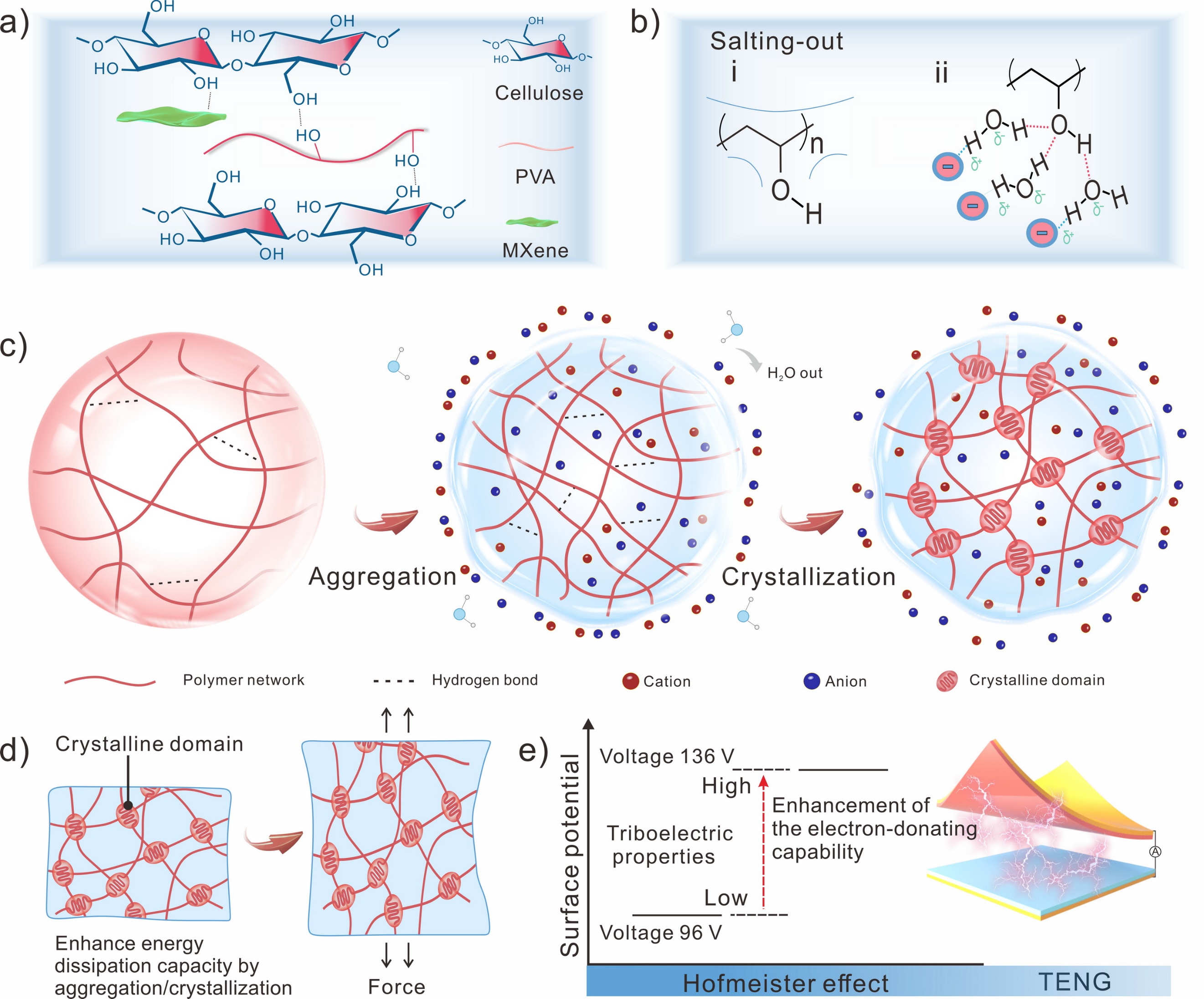
Flexible thin-film materials are widely used in fields such as wearable sensing, bioengineering, and aerospace. However, strength and toughness are often mutually restrictive, making it difficult to achieve both simultaneously. Particularly in the field of triboelectric sensing, materials need to maintain stable performance while possessing good compatibility under complex stress environments, which is a core challenge for achieving precise sensing. The research team proposed a "multilevel crosslinking" strategy for reconstructing hydrogen bond networks. By constructing a gradient hydrogen bond crosslinking network, they simultaneously enhanced the tensile strength and toughness of cellulosic triboelectric materials, breaking through the performance bottleneck of traditional materials. This strategy provides a new approach for the design of high-performance flexible thin films, supporting the development of wearable devices, flexible electronic components, and related fields.

 Address: No.100,East Daxue Road,Xixiangtang District,Nanning, Guangxi,China
 Postal Code: 530004
 Tel: 86-771-3238863
 Email: gjc@gxu.edu.cn